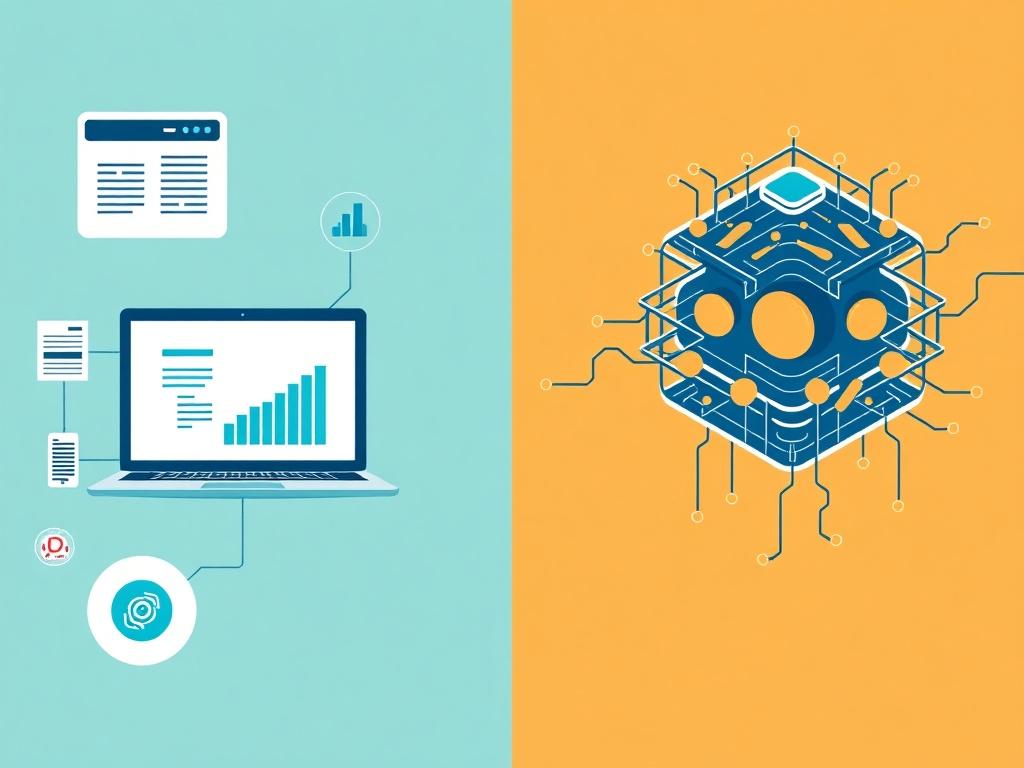
Machine Learning vs. Deep Learning for Personal Projects: A Practical Guide
Introduction
Deciding between traditional machine learning (ML) and deep learning (DL) is one of the first choices you'll face when starting a personal project involving data. Both approaches can solve prediction, classification, and pattern-recognition problems—but they differ in data needs, compute requirements, development workflow, and interpretability. This article helps you choose the right approach and gives practical tips to get results quickly.
High-level Differences
What is Machine Learning?
Machine learning typically refers to algorithms that learn patterns from engineered features—examples include linear regression, decision trees, random forests, gradient boosting (e.g., XGBoost, LightGBM), and clustering methods. ML often requires manual feature extraction and domain knowledge.
What is Deep Learning?
Deep learning uses neural networks with many layers to automatically learn representations from raw data (images, text, audio, time series). Common architectures include convolutional neural networks (CNNs) for images, recurrent/transformer models for sequences and text, and fully connected networks for tabular tasks.
Key practical contrasts
In short: ML tends to be simpler, faster to prototype, and more interpretable for smaller datasets. DL shines with large datasets and unstructured data (images, audio, text) and benefits from GPUs and pre-trained models.
When to Choose Machine Learning
Use ML if:
- You have a small or medium-sized dataset (hundreds to a few thousand examples).
- The data is tabular and features are informative or easy to engineer.
- You need fast iteration, low compute costs, or explainability.
- Your goal is a quick proof-of-concept or a lightweight deployed model (e.g., on a microservice or edge device).
When to Choose Deep Learning
Use DL if:
- You have a large dataset (thousands to millions of examples) or can use transfer learning.
- Your data is unstructured (images, raw audio, natural language).
- You need state-of-the-art performance on complex tasks where representation learning helps.
- You accept higher compute costs and longer training times.
Data and Compute Considerations
Data Size and Quality
More data usually favors DL. For small datasets, ML algorithms with careful feature engineering and cross-validation often outperform poorly trained deep models. If you lack data, consider data augmentation, synthetic data, or transfer learning with pre-trained models.
Compute and Time
ML models train quickly on CPUs and are easier to iterate. DL often requires GPUs for practical training times, though small models and fine-tuning pre-trained networks can work on a decent laptop or a single GPU in the cloud.
Development Workflow and Tools
Rapid Prototyping
Start simple: define the problem, explore data, build a baseline with a straightforward ML model (e.g., logistic regression or random forest) and a sensible metric. Baselines set expectations and reveal quick wins.
Common Libraries
- For ML: scikit-learn, XGBoost, LightGBM, CatBoost.
- For DL: TensorFlow/Keras, PyTorch, Hugging Face Transformers for NLP.
- For both: pandas, NumPy, matplotlib/Seaborn for EDA, and MLflow/DVC for experiment tracking and data versioning.
Techniques to Bridge the Gap
Feature Engineering vs Representation Learning
In ML you invest time in feature engineering (aggregations, encoding, scaling). In DL you rely on the network to extract features—useful when raw patterns are complex or subtle.
Transfer Learning and Fine-tuning
Transfer learning is often the fastest route to DL success on personal projects: take a pre-trained model, replace the final layers, and fine-tune on your dataset. This reduces data and compute needs dramatically for tasks like image classification and NLP.
Practical Tips for Personal Projects
Start with Baselines
Always build a simple baseline (e.g., majority class predictor, linear model). This prevents over-investing time in complex models that don't deliver much improvement.
Use Cross-Validation and Robust Metrics
Prefer k-fold cross-validation for small datasets. Choose metrics relevant to your goal (accuracy, F1, precision/recall, ROC AUC, mean absolute error) and monitor both validation and test sets to detect overfitting.
Keep Models Lightweight When Needed
If you must deploy to mobile or edge, favor smaller architectures or ML algorithms. Consider model quantization, pruning, and ONNX conversion for inference speed and smaller footprint.
Leverage Pre-trained Models and APIs
For many personal projects, pre-trained models or hosted APIs (vision/text/audio) provide instant capabilities without heavy training. Hugging Face, TensorFlow Hub, and model zoos are excellent resources.
Project Ideas by Approach
Great ML Projects
- Predictive analytics on personal finance or fitness data (tabular).
- Recommendation systems for small datasets (collaborative filtering + feature engineering).
- Time-series forecasting using ARIMA, Prophet, or gradient boosting.
Great DL Projects
- Transfer learning for image classification (pets, plants, personal photos).
- Sentiment analysis or custom text classification with transformer fine-tuning.
- Voice command recognition with small CNNs or RNNs and data augmentation.
Debugging and Interpretability
ML Interpretability
Tools like SHAP, LIME, and feature importance from tree models help explain predictions. This is valuable for trust and iterative feature improvement.
DL Debugging
DL models are harder to interpret, but techniques like attention visualization, Grad-CAM for images, and embedding inspection can help. Monitor training curves, loss components, and activations to diagnose issues.
Deployment and Cost Management
For personal projects, consider serverless inference, lightweight containers, or edge deployment. Manage cloud costs by using preemptible/spot instances, smaller GPUs, or training locally when feasible. Use model distillation to reduce inference cost.
Final Recommendations
- Start simple: build a quick ML baseline to understand the problem and data.
- Use DL when your data is large, unstructured, or when pre-trained models provide a clear advantage.
- Leverage transfer learning to lower the barrier to DL success.
- Focus on reproducibility: track experiments, version data, and keep code modular for easy iteration.
- Balance accuracy with practicality: computation time, interpretability, and deployment constraints matter for personal projects.
Resources to Explore
Look into scikit-learn tutorials for ML basics, fast.ai and Hugging Face for practical DL workflows, and community-driven datasets and notebooks for inspiration. Practical hands-on experiments are the fastest way to learn.
Conclusion
Both machine learning and deep learning have places in personal projects. Choose based on data type and size, available compute, development speed, and the importance of interpretability. Start with a baseline, iterate, and use transfer learning and model optimization techniques to get the best results with the least friction.
Share This
Latest Blog


AI w Diagnostyce Medycznej i Obrazowaniu
15 Oct 2026
AI in Video Editing and Media Production
12 Oct 2026