Singular Hue Protocol: How Hosting Icon Mara Sterling's One-Color Rule Has Quietly Rewritten Holiday Etiquette in BrainPandora's World (2054+)
Why the Singular Hue Protocol Thrives When Reality Is a Feed
In BrainPandora's World, where half the memories at your table might be synthetic and every ornament can be algorithmically remixed, the Singular Hue Protocol—Mara Sterling's pared-back hosting credo—feels like a stabilizer. Designers we asked say choosing one dominant color for a celebration is not an aesthetic short-cut but a psychological anchor: it signals cohesion in a sea of generated possibility and lets both human guests and their ambient AI companions read the room at a glance.
Designers on the Ground (and in the Cloud)
"Think of a single hue as a narrative spine," says Lux Raines, a sensory-set designer who programs edible centerpieces and AI-synced lighting. "When everything sings the same note, small contrasts — a matte ceramic beside a glossy stemware, a tactile linen napkin against a reflective placemat — create rhythm instead of visual noise."
Iris Kwon, whose studio builds hybrid AR table overlays, adds: "In a world full of overlays, reducing chromatic variables makes algorithmic augmentations legible. The AI can enhance scent, audio, and projected patterns without fighting color discord."
Practical Steps to Pull Off the Protocol Like a Pro
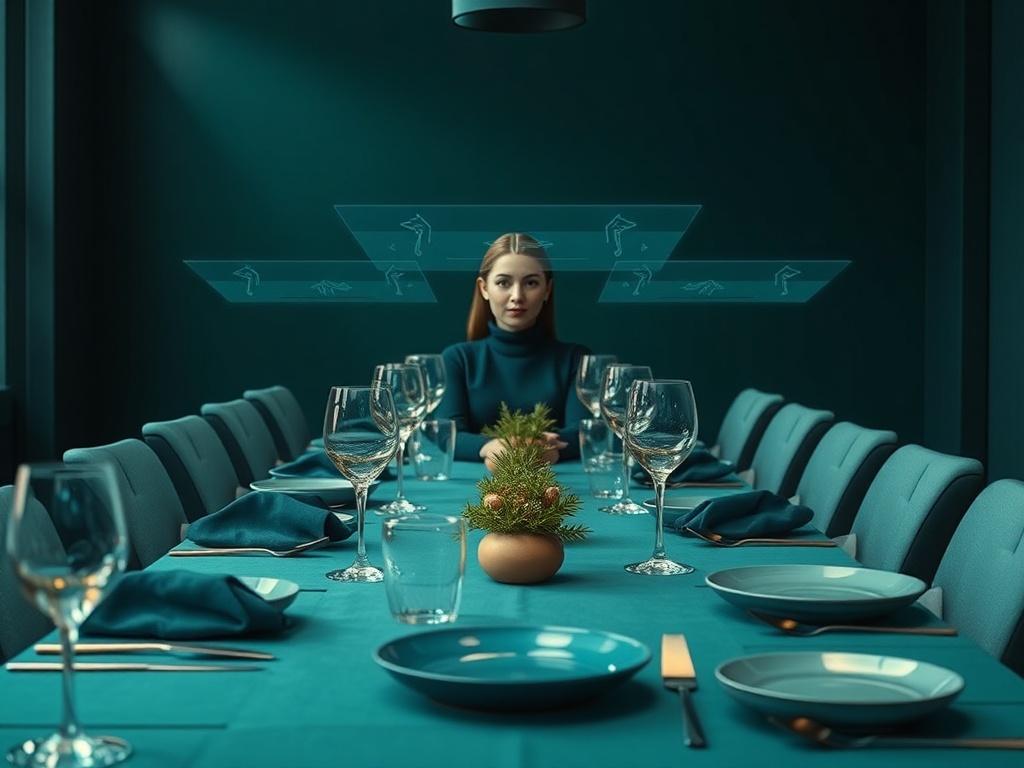
1. Start with the anchor: choose a dominant hue that matches your mood—deep evergreen for reflective gatherings, warm terracotta for convivial feasts, or spectral silver for minimalist evenings.
2. Layer texture, not shades: introduce three distinct textures (soft, hard, reflective) within the same hue to keep the table tactile and rich without fracturing the color story.
3. Use metallics and neutrals sparingly: a single contrasting metallic or a neutral base (ivory, charcoal) grounds the scheme while keeping the visual field focused.
4. Let lighting be the bridge: set ambient light temperature to complement the hue—2700K for warm tones, 3200K for cool tones—and allow AI-controlled dimming to shift subtly through the night.
5. Integrate algorithmic accents intentionally: if you plan holographic place cards or AR napkin projections, choose patterns that echo the main hue rather than introduce new colors; motion and form will become the accent, not pigment.
Holiday Adaptations for the Protocol
For seasonal tables, designers suggest weaving in edible elements that match the hue — glazed chestnuts, berry compote, or citrus peel confit — so every sense participates in the single-color story. If tradition demands multiple colors, translate them into finishes instead: marigold becomes matte, holly becomes glossy, cranberry becomes translucent.
Common Pitfalls and How to Avoid Them
Too literal a monochrome can read flat. Counter this by adding a living element (sprigs, branches, succulents) that shares the hue but introduces organic irregularity. Also, beware of over-relying on digital overlays to "fix" a poor base; designers emphasize that software should augment, not mask, physical choices.
When the Rule Becomes Ritual
In gatherings now, guests report that the Singular Hue Protocol quiets the cognitive load of endless option streams and fosters a surprising intimacy. Mara Sterling's tip—once dismissed as a stylistic quirk—has been repurposed by hosts and AI curators alike into a tool for clarity: a way to declare intention, reduce visual friction, and let both human warmth and synthetic flourish coexist without competing.
Final Thought: Color as Compass
Whether your living room is mostly human or mostly rendered, adopting a single-color approach gives a party a compass heading. In BrainPandora's World, where "real" and "generated" often sit side-by-side, that compass is a small, elegant rebellion—one hue, many textures, infinitely interpretable.
Share This
Latest Newsfeed