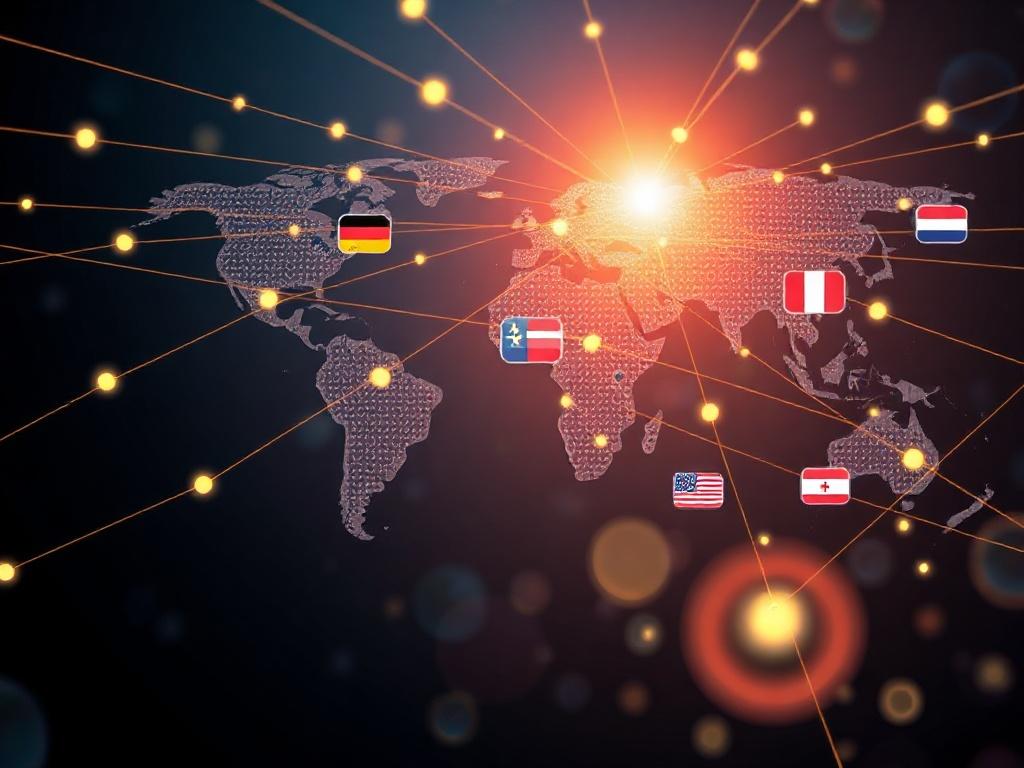
AI-Powered Language Translation: Bridging Worlds, One Word at a Time
The Dawn of Seamless Communication
For centuries, the dream of effortless communication across linguistic barriers has captivated humanity. From the biblical tale of the Tower of Babel to the modern-day struggles of international business and travel, the need to understand and be understood has been a constant endeavor. Today, this dream is rapidly becoming a reality, thanks to remarkable breakthroughs in AI-powered language translation.
From Clunky to Conversational: The Evolution of Translation Technology
Early machine translation systems were notoriously rudimentary. They relied on rule-based approaches, meticulously programmed dictionaries, and grammatical structures. The results were often stilted, nonsensical, and far from natural. Think of early online translators producing output that required as much effort to decipher as the original text.
The paradigm shift arrived with the advent of Neural Machine Translation (NMT). Inspired by the human brain, NMT models process entire sentences, considering context and semantic relationships, rather than translating word-by-word. This has led to a dramatic improvement in fluency, accuracy, and the overall naturalness of translated text. The quality has moved from being a novelty to a truly functional tool.
Key AI Breakthroughs Fueling the Revolution
Several key AI advancements have propelled language translation into its current impressive state:
Deep Learning and Neural Networks
At the core of NMT lies deep learning, a subset of machine learning that utilizes multi-layered neural networks. These networks can learn complex patterns and nuances in language from vast datasets, enabling them to generate more human-like translations.
Transformer Architecture
Introduced in 2017, the Transformer architecture revolutionized NMT. Unlike previous models, Transformers use an "attention mechanism" that allows them to weigh the importance of different words in a sentence when translating. This has significantly improved the handling of long-range dependencies and complex sentence structures.
Contextual Embeddings
Techniques like Word2Vec and, more recently, large language models (LLMs) like GPT and BERT, have introduced contextual embeddings. These represent words as vectors in a multi-dimensional space, where words with similar meanings and contexts are located closer together. This allows AI to better understand the nuances of word usage and disambiguate meanings.
Low-Resource Language Translation
Traditionally, high-quality translation required massive amounts of parallel text data. AI is now making strides in "low-resource" languages, where such data is scarce. Techniques like transfer learning and zero-shot translation are enabling AI to translate languages with significantly less training data, making communication accessible to a wider global population.
The Impact and Future of AI Translation
The implications of these AI breakthroughs are profound:
Democratizing Information
AI translation breaks down language barriers, making knowledge and information accessible to everyone, regardless of their native tongue. This empowers education, research, and personal growth on a global scale.
Transforming Business and Commerce
International business transactions, customer support, and global marketing are becoming seamless. Companies can now connect with customers and partners worldwide with unprecedented ease.
Enriching Cultural Exchange
Literature, art, and media can be shared and appreciated across cultures more readily. This fosters understanding, empathy, and a richer global cultural tapestry.
Enhancing Travel and Personal Connections
Traveling to foreign countries is less daunting, and personal relationships can flourish across linguistic divides. Real-time translation apps are becoming indispensable travel companions.
Challenges and the Road Ahead
While the progress is astonishing, challenges remain. Nuances of humor, sarcasm, idiomatic expressions, and cultural context can still pose difficulties for AI. The ethical considerations of data privacy and the potential impact on human translators are also important areas for ongoing discussion and development.
However, the trajectory of AI-powered language translation is undeniable. We are witnessing a future where language is no longer a barrier, but a bridge, connecting humanity in ways we could only have imagined. The ongoing evolution of AI promises even more sophisticated and nuanced translation capabilities, bringing us closer to a truly interconnected world.
Share This
Latest Blog


AI w Diagnostyce Medycznej i Obrazowaniu
15 Oct 2026
AI in Video Editing and Media Production
12 Oct 2026